Abstract
Lithium-ion batteries (LiBs) are widely used in numerous applications, and accurate estimation of their Remaining Useful Life (RUL) is critical for ensuring safety and reliability. Existing data-driven methods for battery degradation prediction typically treat battery parameters independently, neglecting the relational dependencies that exist among them.
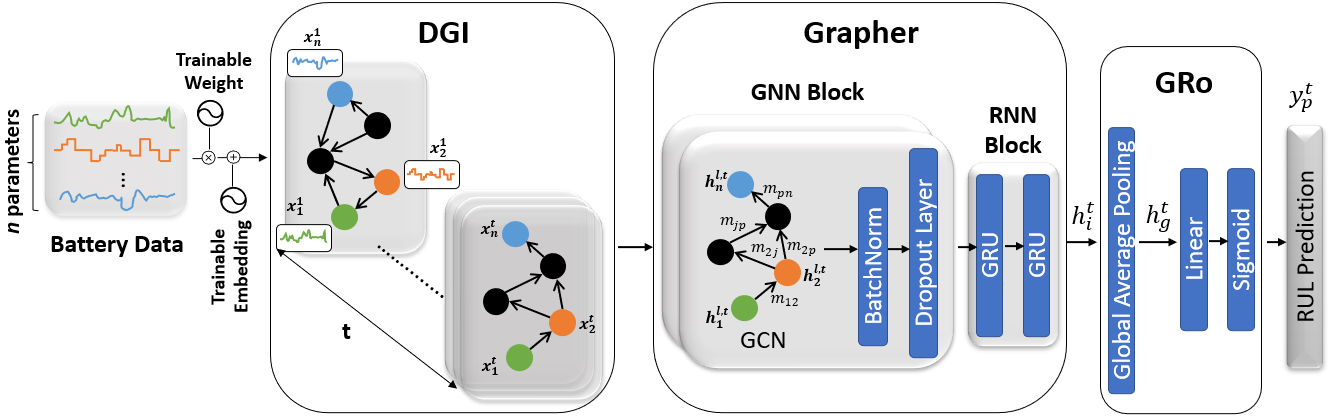
We propose Battery GraphNets (BGN), a novel framework that jointly learns a discrete dependency graph structure between battery parameters and employs a graph-learning algorithm to model the intrinsic degradation patterns of lithium-ion batteries for Remaining Useful Life (RUL) prognosis. BGN adopts a bi-level approach: a Dynamic Graph Inference (DGI) module learns evolving graph structures via Gumbel-softmax sampling, while a Grapher module combining GNN and RNN blocks encodes local-graph neighborhood information and long-range spatio-temporal dependencies, followed by a Graph Readout for graph-level representation.
By explicitly modeling the relationships between battery parameters through dynamic graphs, Battery GraphNets captures the complex degradation mechanisms that govern battery health, enabling more accurate and interpretable life estimation compared to conventional approaches.
Key Highlights
Architecture
Battery GraphNets consists of three core components working in a bi-level optimization framework. The Dynamic Graph Inference (DGI) module learns time-evolving dependency graphs between battery parameters using Gumbel-softmax sampling, enabling differentiable discrete structure learning. The Grapher module combines GNN blocks for encoding local-graph neighborhood information with RNN blocks for capturing long-range temporal dependencies in degradation patterns. Finally, a Graph Readout module aggregates node-level representations into a graph-level representation for the downstream RUL prediction task.
Key Contributions
- Dynamic Graph Inference: Learns time-evolving dependency graphs between battery parameters using Gumbel-softmax, capturing changing relationships during degradation.
- Bi-Level Framework: Jointly optimizes graph structure learning and degradation prediction in a unified end-to-end framework.
- Spatio-Temporal Encoding: Combines GNN for spatial relational learning with RNN for temporal degradation pattern modeling, capturing both local and long-range dependencies.
- Industrial Impact: Addresses practical battery health monitoring for lithium-ion batteries, enabling safer and more reliable deployment in real-world applications.