Abstract
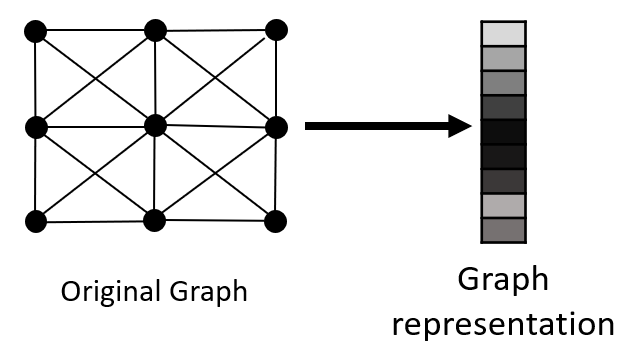
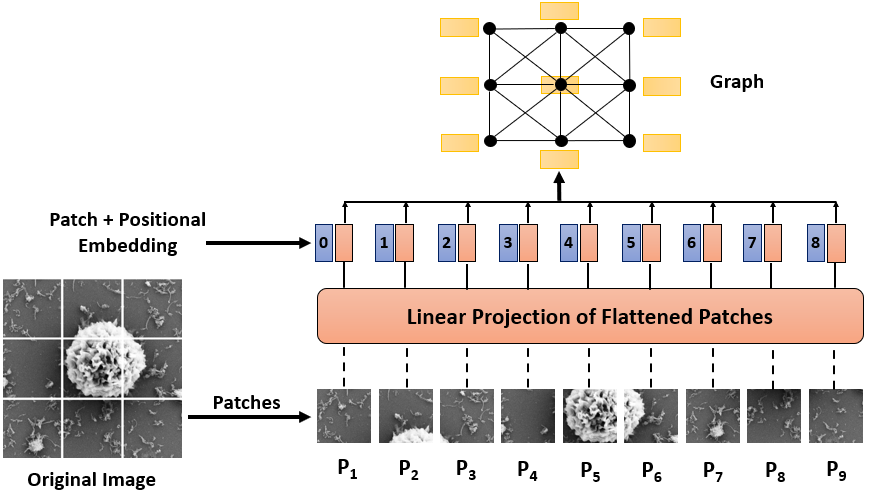
EMCNet is an end-to-end electron micrograph representation learning framework for nanomaterial identification. It addresses the key challenges of classifying electron micrographs, including high intra-class dissimilarity, high inter-class similarity, and multi-spatial scales, by representing images as patch-attributed grid graphs and using multiple graph encoders.
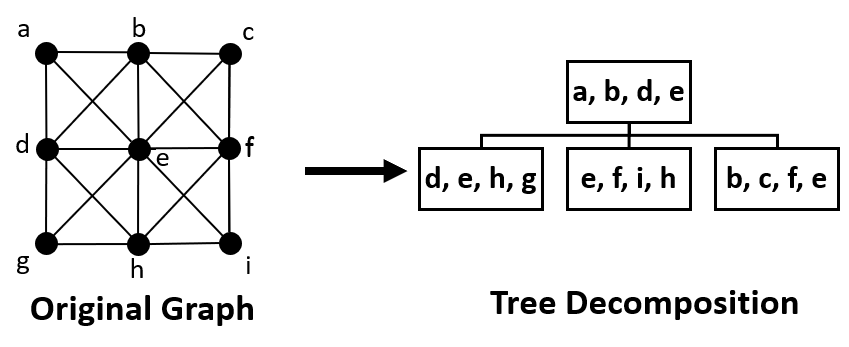
The framework employs three parallel pathways: a Graph Encoder (GEnc) for neighborhood aggregation, a Hierarchical Graph Encoder (HGEnc) for layer-wise local-graph pooling and higher-order message passing, and a Clique Tree Encoder (CTEnc) that operates on tree decomposition to learn local substructures. Together, these encoders capture multi-scale structural information from the electron micrographs for robust nanomaterial classification.
Key Highlights
Architecture
EMCNet converts electron micrographs into patch-attributed grid graphs, where each patch becomes a node with feature attributes derived from the image content. These graphs are then processed through three parallel encoder pathways: GEnc performs neighborhood aggregation on the grid graph, HGEnc applies layer-wise local-graph pooling and higher-order message passing for hierarchical feature extraction, and CTEnc operates on the tree decomposition of the graph to capture local substructure patterns. The outputs of all three encoders are combined for final nanomaterial classification.
Key Contributions
- Grid Graph Representation: Novel approach to represent electron micrographs as patch-attributed grid graphs, enabling graph-based learning on microscopy images.
- Triple Encoder: Three parallel pathways (GEnc, HGEnc, CTEnc) for multi-scale feature extraction, each capturing complementary structural information.
- Tree Decomposition: Uses clique tree encoder for learning local substructure patterns from the graph decomposition.
- Nanomaterial Classification: Addresses real-world challenges in electron micrograph analysis including high intra-class dissimilarity and inter-class similarity.
Results
EMCNet demonstrates effective nanomaterial classification by leveraging the complementary strengths of its three parallel graph encoders, capturing both local neighborhood patterns and higher-order structural information from electron micrographs.