Abstract
Vision Hypergraph Neural Networks (Vision-HgNN) is a hypergraph-based backbone architecture for electron micrograph classification that models higher-order dependencies between image patches, going beyond pairwise relations. Traditional methods such as Convolutional Neural Networks, Vision Transformers, and Graph Neural Networks fail to capture higher-order relationships among spatial regions in electron micrographs.
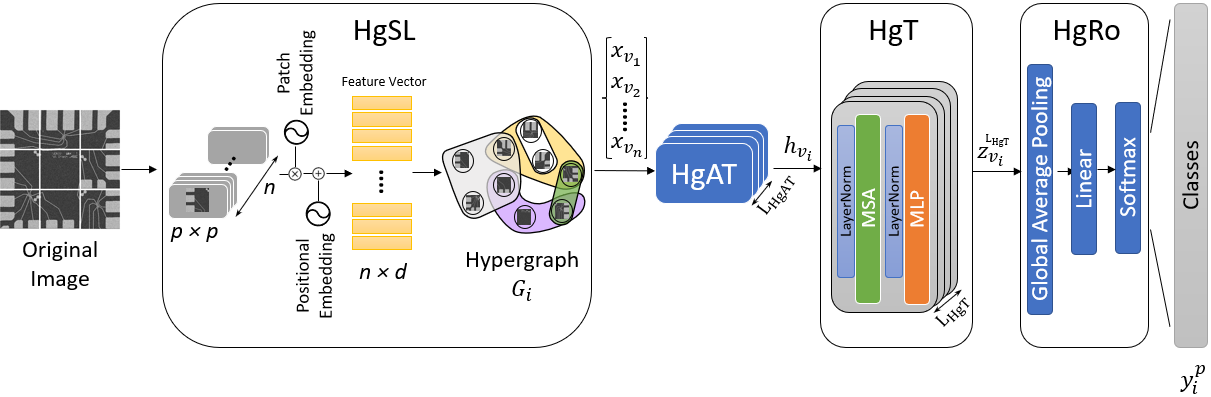
Vision-HgNN represents micrographs as visual hypergraphs where image patches serve as hypernodes. The architecture comprises four core modules: Hypergraph Structure Learning (HgSL) for constructing the hypergraph topology, Hypergraph Attention Network (HgAT) for capturing short- and moderate-range dependencies, Hypergraph Transformer (HgT) for modeling long-range pairwise interactions, and Hypergraph Read-out (HgRo) for producing graph-level embeddings for downstream classification.
Key Highlights
Architecture
Vision-HgNN introduces a novel visual hypergraph representation paradigm for scientific imaging. The architecture constructs hypergraphs from electron micrograph patches using Hypergraph Structure Learning (HgSL), then processes them through Hypergraph Attention Networks (HgAT) for local spatial interactions and Hypergraph Transformers (HgT) for global long-range dependencies, before aggregating via Hypergraph Read-out (HgRo) for classification.
Key Contributions
- Hypergraph Backbone: First hypergraph-based vision architecture for electron micrograph classification.
- Higher-Order Modeling: Captures beyond-pairwise relationships using hyperedges connecting multiple patches.
- Multi-Scale Attention: Combines HgAT for local and HgT for global spatial interactions.
- Novel Representations: Introduces visual hypergraph representation paradigm for scientific imaging.
Results
Vision-HgNN demonstrates the effectiveness of hypergraph-based higher-order modeling for electron micrograph classification, outperforming traditional pairwise approaches by capturing richer spatial relationships among image patches.